


Bonjour ! It’s been a while since I’ve posted about something other than job opportunities, so this is a long time coming. There are already detailed, comprehensive articles on France’s healthcare system, such as this one from Expatica, so this post is primarily geared towards Teaching Assistants. In the following paragraphs, you will hopefully learn more about:
– the basics of the French healthcare system,
– how to apply to ouvrir des droits,
– what a médecin traitant is and how to declare one,
– the gist of reimbursements,
– a little info on mutuelles,
– how to find doctors, and
– my personal experiences with the system.
Here we will only scratch the surface, but I will provide multiple links throughout in case you want to learn more.

Super Short Overview of the French Healthcare System
France has a healthcare system that offers universal coverage for all citizens and residents. Government-funded agencies cover more than 75% of health expenditures in France, with residents contributing to the system through cotisations sociales. For teaching assistants, these cotisations sociales (which also cover things in addition healthcare, such as retirement, unemployment, etc.) comprise that amount that gets taken out of your paycheck every month, and why the net amount (which is the pay that goes into your bank account) is substantially lower than the gross- or brut – amount. You might hear different terms like La Sécurité sociale, or La Sécu, and l’Assurance Maladie. Just to clear this up right away, l’Assurance Maladie is the part of La Sécu that manages the general healthcare system and most directly applies to you. For more information, check out Ameli, the téléservice for l’Assurance Maladie.
How to Apply
Your school is supposed to help you with this, but you can also take matters into your own hands like I did. When you arrive, you will be issued a temporary social security number so you can be paid. This is NOT the number you will use to get healthcare coverage, so consider applying for your official social security number right away. To demander l’ouverture des droits a l’assurance maladie, you will need to fill out Cerfa/Formulaire 15763*02, which can be downloaded here. Those who work in France may apply right away, while those who reside in France without a job may apply after three months. In addition to filling out the form, you must also attach the following pièces justificatives: a copy of your visa to prove legal residency, a copy of your passport, an original birth certificate, proof of employment (such as a copy of your arrêté de nomination), proof of address, and your RIB aka your French bank account info.
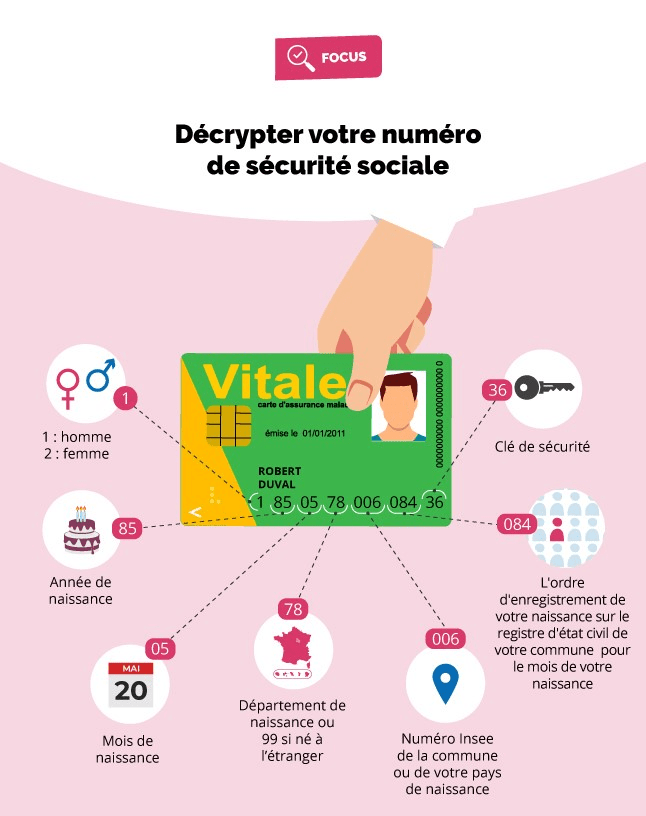
Once that information is processed, you will receive an official social security number. BUT that isn’t the last step. While the numéro de sécurité sociale is enough to start getting reimbursed, the process will be simplified once you have a carte Vitale. You’ll be asked to send additional documents, including an ID photo and proof of identity, and then you will be issued your carte Vitale. This took about 4 months from my arrival, but could have been faster if I had initiated the process right away rather than waiting for my school. We will learn more about why a carte Vitale is helpful in the following section. In the meantime, here is more information from Ameli on how to get your first carte Vitale.
Reimbursement
For the tarif de base / tarif de convention (TC), meaning the state-set prices for medical visits, procedures, medications, etc., there are different levels of reimbursements. For most medical acts, you will be reimbursed 70% of the total cost, leaving 30% for you to pay. If you’re from the US you might still be fretting about how to pay that 30%, but don’t worry! In France, seeing a generalist costs 25€, with a reimbursement of 17,5€ (though this becomes 16,5€ when the symbolic 1€ of participation forfaitaire is deducted), leaving only 7,5€ to you. However, if you choose to go hors parcours de soins, meaning you have not declared a médecin traitant (more on this in a moment) or gone through them first, you will only be reimbursed at a rate of 30%. For more info on reimbursement, here is Ameli’s Tableaux récapitulatifs des taux de remboursement.
While this post mainly focuses on doctor visits, you can find information on reimbursement for medications here.
Even if it takes some time to receive your official number or your carte Vitale, you are eligible for coverage from the date that your contract starts. Be sure to ask medical professionals for a feuille de soins, which you can then complete later with your number and send for reimbursement.
The purpose of the carte Vitale is to not have to font the entire cost and await reimbursement. Your carte Vitale will contain all relevant information to simplify the reimbursement process. Rather than collecting a feuille de soins and sending it off, your carte Vitale transmits all information directly to your primary insurance center (which is the CPAM – or caisse primaire d’assurance maladie- de Paris for all Language Assistants), and you will be reimbursed within 5 days. For medical offices that practice tiers payant, you won’t have to wait for reimbursement at all, and will only pay your portion of the costs (which is typically, you got it, 30%).
The Médecin Traitaint
In France, you must declare a médecin traitaint, or primary care doctor, to get maximum reimbursement. This can be a generalist or specialist, but I’d recommend a generalist. You’re also supposed to get a referral from your primary care doctor to get maximum reimbursement from most specialists (there are some exceptions, including gynecologists, ophthalmologists, and a few others, which do not require referrals).
You can declare your médecin traitant online at the doctor’s office if you have your carte Vitale, or fill out the Déclaration de Choix du Médecin Traitaint document with your doctor during a consultation and send it to your CPAM. According to this Ameli forum, it is possible to declare without your numéro de sécurité sociale définitif. For more information on the médecin traitant including a PDF of the declaration form, see this post from Ameli.
Sectors 1 and 2
Remember a few paragraphs ago when I said that a consultation with a general practitioner costs 25€? Well, this isn’t always the case. Doctor visits can vary in price depending on whether the doctor is conventionné or non conventionné, and depending on their sector. Conventionné means that the doctor has agreed to respect the prices set by the state. Additionally, specialists cost more, but you will still be reimbursed at a rate of 70% in sector 1. For the cost of different types of consultations, click here.
Secteur 1: In sector 1, a médecin conventionné uses prices fixed by the convention nationale and does not have excess fees. This is the least expensive option. When the reimbursement rate is 70%, this is referring to 70% of state-set, sector 1 fees. So in the example I gave above where you see a GP who charges 25€, this doctor is conventionné secteur 1.
Secteur 2: In sector 2, doctors can set excess fees, and charge more for services. You will find many specialists in this sector (though there are certainly specialists in sector 1, too), and these appointments will be more expensive. You will not get 70% reimbursed from the total cost. That 70% applies to state-set prices. So if your visit costs 50 €, you are still only going to be reimbursed 16,50€ because the calculation is made based on the state-set costs, not the cost of your appointment.
If a doctor is non conventionné, they are free to charge whatever they want and you will be reimbursed 0,61€ for an appointment with a generalist, and 1,22 € chez un spécialiste. There are very few doctors like this in France.
For more info, see this page from the French government’s website.
Mutuelle
If you’re wondering how you can be fully reimbursed, then this section is for you! As you know by now (if I’ve done what I’ve set out to do in this blog post…), when you see a doctor, the state reimburses 70% of the state-set costs. A mutuelle is a top-up which covers the deficit, or the part of the cost that you’d normally be left to pay. The most basic mutuelles will cover 100% of state-set costs.
But what about doctors that practice dépassements d’honoraires? The government still only reimburses 70% of state-set costs, so how can I offset this? If you’re asking those questions, you might want a mutuelle that covers 150%, or 200% of the tarif de convention (TC). To illustrate this, let’s translate the example from mutuelle-conseil.com. You see a generalist who charges 40€, which is quite a bit higher than the 25€ state-set cost. If your mutuelle covers you at a rate of 100%, it will cover you at 100% of the state-set 25€ TC. However, that still leaves you with 15€ (40€ [the cost of your visit]-25€ [100% reimbursement of state-set costs]). In this case, it is interesting to have a mutuelle that covers more than 100% of TC. If you have a mutuelle that reimburses 200% of the tarif de convention, then you can be reimbursed up to 50€ for an appointment with a generalist (25€*200%). This means that the mutuelle would fully cover your 40€ appointment (minus 1€ of participation forfaitaire, which the mutuelle cannot cover).
Even if you’re generally in good health, it’s a good idea to have a mutuelle for a possible hospital stay in France. While l’Assurance Maladie reimburses 80% of the costs at a public hospital, there are plenty of things it does not cover, including a 20€ forfait hospitalier per day, any dépassements d’honoraires, which are quite common for anesthesiologists and surgeons to put into practice, and private rooms, which cost an average of 60€ per day. For example, my basic-level mutuelle covers me at 100% of TC for pretty much everything, except hospital stays, where I’m covered at 300% of TC to ensure I won’t have to pay a ton of money if something unexpected happens resulting in hospitalization.
Many mutuelles also offer a certain allotment per year or per session for health services that do not get reimbursed by the state, such as cognitive-behavioral therapy, acupuncture, elective vaccines (like a flu shot), a visit with a dietician, etc. My mutuelle is through Groupama, and I’ve been very satisfied with their service.
Finding doctors
Now that you know the basics of the French healthcare system and how it might relate to you as a Language Assistant, here is how to find doctors in France. The site I use most frequently is Doctolib. On Doctolib you will be able to see the doctor’s name, contact information, their specialty, their sector, and means of payment. There are other directories such as Keldoc and RDV Médicaux, and you can also find doctors on Ameli. With the pandemic, video appointments have become more popular. You can find these on Doctolib, and, though I’m less familiar with the other sites, I imagine they show video appointments as well.

If you’re not super comfortable yet in French, Doctolib will show you other languages doctors speak. I think this information is self-reported, though, and sometimes doctors say they speak another language, but the level is very low.
Expatica goes into detail on finding doctors in France, so check out their post.
Wrapping Up
On a personal level, I’ve been very thankful for France’s healthcare system. In my home country, people literally die because they cannot afford to see a doctor. It’s sickening and breaks my heart. Here, nobody needs to worry about going bankrupt from getting a lump checked or ensuring they have enough insulin. I had a minor health scare back in 2018 when a test for digested blood came back positive, which could be indicative of colon cancer. I was able to see a doctor immediately, who then scheduled me for an exploratory procedure to rule it out (I’ll spare you all the details, but if you’ve had digestive issues, you probably know this procedure all too well…).
Another thing to note is that doctors here might not be as warm as doctors from your home country (if you’re from the US, at least). Some practice excellent bedside manner, while some just do their job. My friends and I have had doctors make us cry because of how abrupt or cold they’ve been, so consider trying to track down reviews before you decide who to see. Overall, though, my experiences have been very positive.
You should also be aware of the fact that medical nudity is viewed differently here, with little privacy. You won’t get a gown or modesty paper when you see the gyno, you’ll often strip in front of your doctor, and so on. Eventually you will adjust to it, but this is something to be aware of for anybody who is embarrassed to be naked in front of a doctor, or for survivors of sexual violence. Please take this warning so you are not shocked or traumatized when the time comes (because it will. Almost all assistants get called in for a chest x-ray, where you of course won’t have to disrobe in front of other patients, but you’ll be walking into the exam room with a naked torso).
Anyway, there you go. I hope this was helpful! Feel free to leave any questions or remarks in the comment section, and I’ll do my best to direct you to the proper resources. A bientôt !
 Emily à l'Etranger
Good information !! I have been shopping around for mutuelles recently and all the choices and jargon is very overwhelming ! I want to add this site onto the radar for any person searching for a gynecologist in France. It’s a crowd-sourced list of doctors who are feminist, LGBT-friendly, sex positive etc. https://gynandco.wordpress.com/
LikeLike
Thanks, Anne! What a great website recommendation.
LikeLike
Emily, you are the best.
All your explanations are on point and very helpful.
As assistant de langue, we need people like you to direct and explain things to us.
I learnt a lot from this write-up. It has literally answered all my questions.
Please keep doing this good work.
LikeLike
Thanks for the kind message! I’m so glad I could help.
LikeLike